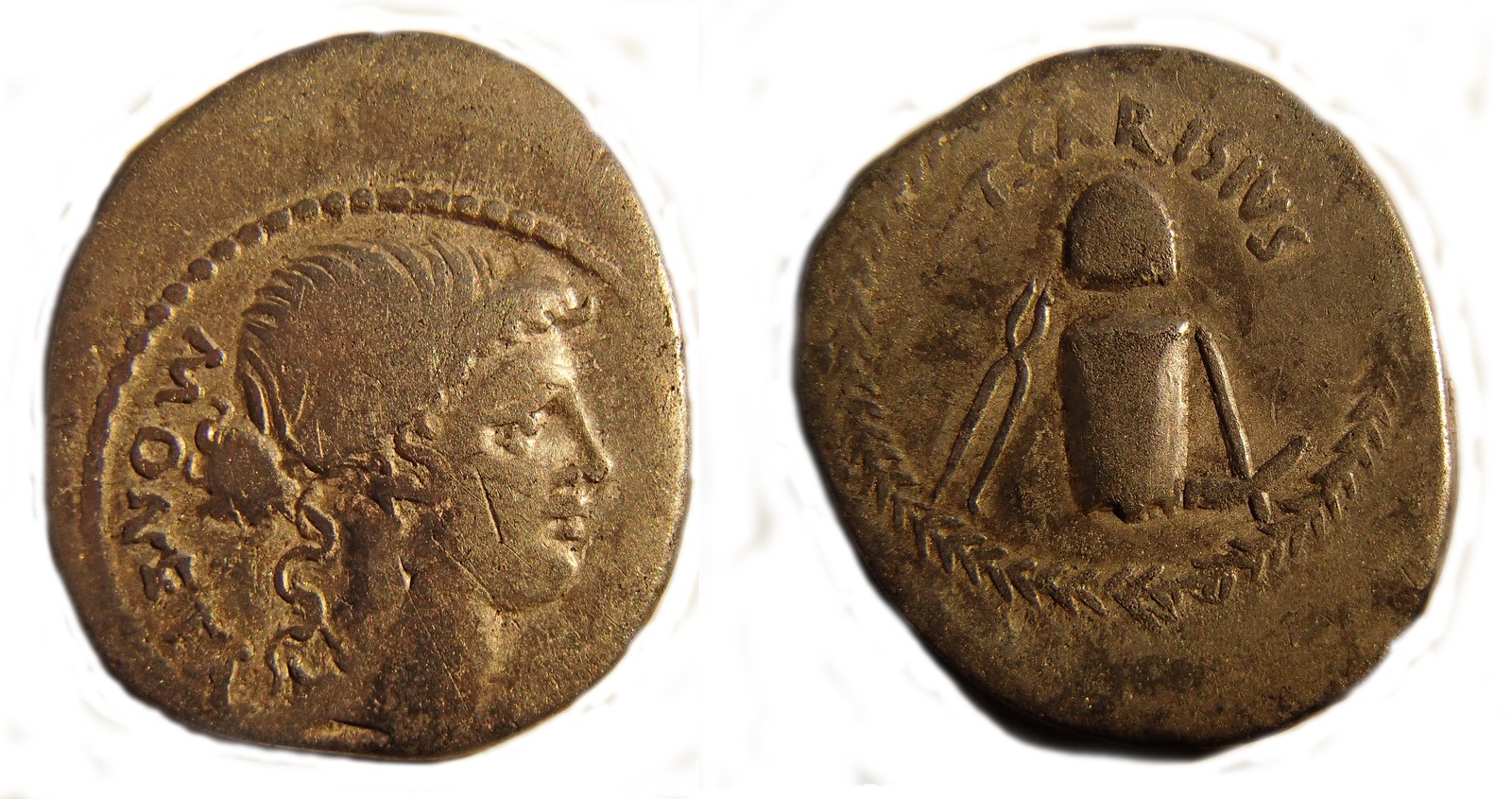
A silver denarius struck in Rome around 46 BC carries, on one side, the head of a goddess with her hair carefully dressed and a single word behind her: MONETA. On the other side there is no god, no battle, no famous ancestor. There is a workshop. In the centre stands an anvil, with an object resting on top of it, flanked by a pair of tongs and a hammer, all enclosed in a laurel wreath, with the name of the moneyer above: T. CARISIVS.
Few Roman coins are this frank about where they come from. Money usually speaks of victories and virtues; this one speaks about itself. The goddess is Juno in her aspect as Moneta, whose temple stood on the Arx, the northern summit of the Capitoline hill, and the mint of Rome is generally placed close to it. That is how her title passed to the coins and, many centuries later, to our own words money and monetary. Ancient writers explained the title through the Latin monere, to warn, and told more than one story about warnings given by the goddess. Modern scholars treat each of those stories with caution, and the exact site of the mint is still debated, but the thread running from the temple to the workshop to the word is one of the sturdier ones in Roman etymology.
Titus Carisius was one of the young magistrates in charge of the mint in a year when Caesar dominated Rome, and he signed several different designs. This is the one people remember, because it lets us look straight into the room where coins were born. The object on the anvil has kept readers busy for a long time: most see in it the upper die, decorated with a garland, while others prefer the pointed cap of Vulcan, the smith god. I like that the coin keeps a little of its mystery even while it is showing us its own tools.
When I was working on Inside the Roman Mint, this denarius changed the way I approached the whole book. I had planned to begin with emperors, metals and output. Carisius pushed me back toward the hands: the man holding the tongs steady, the man bringing the hammer down, the moment of heat and noise that every one of these small discs had to pass through. The wreath around the tools seemed to say that this work deserved its own honour, and I wanted the chapters to give it that.
Every time I look at it, I come back to the same question. Who decided that a hammer and a pair of tongs belonged on the coin itself? Was it a proud gesture from the workshop, a learned joke about the goddess, or simply a young moneyer who found the ordinary tools of his office more beautiful than any trophy?